COUTURE IN THE AGE OF CONTENT
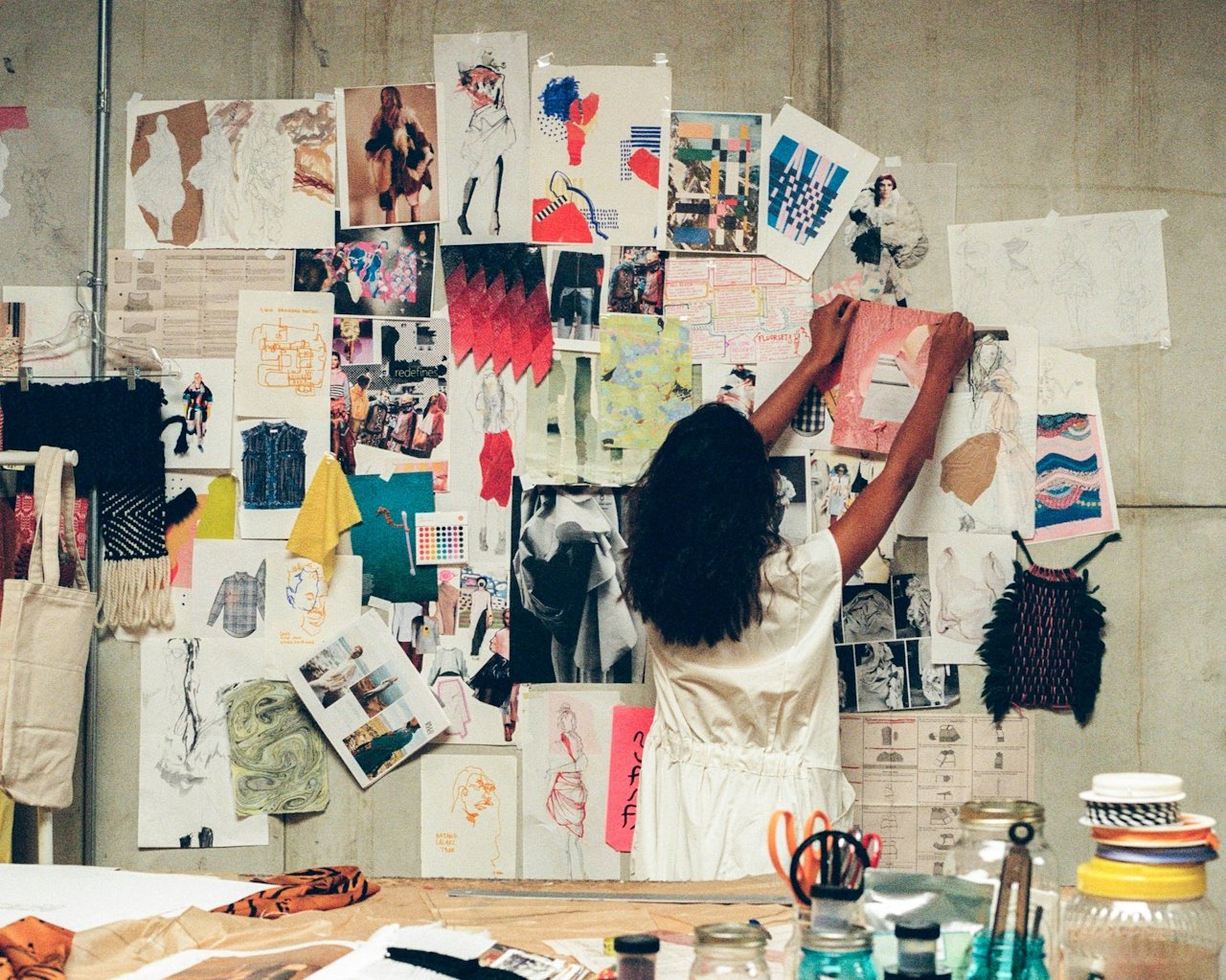
How ateliers balance heritage techniques with digital spectacle.
Couture in the Spotlight
Once, couture lived in private salons: a closed circle of clients, fittings, and ateliers. Today,
couture lives on TikTok, Instagram, and YouTube. A gown can be seen by millions before it even
leaves the runway. For students, this is the paradox of modern couture: it must honor centuries
of handcraft while dazzling an audience that consumes fashion in seconds.
Schiaparelli — Myth Turned Meme
When Daniel Roseberry took the helm at Schiaparelli, he inherited Elsa Schiaparelli’s surrealist
legacy. He has since turned it into digital theater: the lion’s head gown worn by Kylie Jenner at
Paris Couture Week (2023) became an internet sensation within minutes.
What made it couture was not the viral moment, but the process: the lion’s head was sculpted
by artisans using hand-molded foam, resin, and faux-fur embroidery. Here lies the lesson —
behind every meme is meticulous handwork. For students, Roseberry proves that heritage
surrealism and modern virality can coexist.
Loewe — Craft in the Language of the Internet
At Loewe, Jonathan Anderson has transformed couture-like craft into digital storytelling. His
shows often feature garments that break the algorithm: dresses sprouting 3D anthurium flowers
(crafted with artisans and botanists), pixelated gowns that looked Photoshopped but were
woven by hand.
Anderson shows students that craft can be made for the feed without losing integrity. Every
hand-finished seam is as important as the spectacle that travels the internet.
Balenciaga — Trauma, Tailoring, and Theater
Under Demna, Balenciaga has become a lightning rod for digital conversation. While
controversies dominate headlines, the couture atelier continues to produce garments of
staggering craftsmanship: sculptural tailoring, hourglass silhouettes, and hand-embroidered
gowns that take thousands of hours to make.
The couture studio works quietly even as the runway erupts in spectacle. For students,
Balenciaga demonstrates the tension of the age: the digital storm versus the silent labor of the
hand.
Valentino — Pierpaolo’s Poetics
Valentino’s Pierpaolo Piccioli has redefined couture through color and community. His Pink PP
collection (2022) flooded social media feeds, but its success lay in the atelier’s dye work,
tailoring, and embroidery. His couture is often presented in Rome, bridging house heritage with
inclusivity and visibility.
For students, Piccioli is a masterclass in how to turn the quietest gestures — a seam, a silhouette,
a single hue — into both a cultural phenomenon and a digital sensation.
Iris van Herpen — Couture as Future Technology
No discussion of contemporary couture is complete without Iris van Herpen. Her gowns, often
printed with 3D technology or cut from laser-sculpted organza, dominate digital imagery. Yet,
behind each futuristic surface is collaboration with traditional artisans: pleaters in Paris,
embroiderers in India, glassworkers in the Netherlands.
Van Herpen teaches students that “the future” of couture is not about abandoning heritage but
fusing it with new tools — craft as experiment, not relic.
Giambattista Valli — Tulle for the Timeline
Giambattista Valli has built his couture identity around vast explosions of tulle, gowns
engineered to dominate Instagram grids. Yet, each frothy dress is constructed with careful
handwork: layer upon layer of tulle stitched and draped by petites mains in his atelier.
For students, Valli’s work underscores a simple truth: the garments that seem made for likes are
also made by hands, hour after hour, stitch after stitch.
Couture’s New Mandate
Across Paris and beyond, couture houses are walking the same tightrope:
● Heritage: techniques like hand embroidery, pleating, lace-making, and tailoring that
define the essence of couture.
● Spectacle: presentations designed for digital virality — lions, flowers, pixels, pink floods,
or billowing tulle.
For students, this is the challenge of your generation: to create couture that both honors the
silence of the atelier and thrives in the noise of the algorithm.
Couture today is not either/or — it is both/and. Both ancient and futuristic, both hand-stitched
and digitally staged. In the age of content, the houses that endure will be those that, like
Schiaparelli, Loewe, Balenciaga, Valentino, Iris van Herpen, and Giambattista Valli, understand
that every viral image must be rooted in something timeless: the patient intelligence of the
hand.